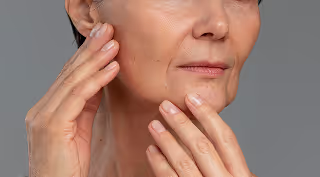

The modern aesthetic landscape is undeniably defined by a phenomenon known as the "Kardashian Effect." For over a decade, this family has served as a primary visual reference for millions, shaping the global definition of "snatched" features and sculpted silhouettes. However, their most significant impact isn't just the look itself, but the method of achieving it. Unlike previous generations of celebrities who vanished for weeks of surgical recovery, the Kardashians have championed a lifestyle of frequent, high-tech "tweakments." This transparency has transformed cosmetic procedures from a shameful secret into a routine wellness and beauty habit, effectively moving the industry's center of gravity from the operating room to the aesthetic clinic.
This shift is driven by the family's pivot toward what experts call "refined realism." While early trends were dominated by exaggerated proportions, the current era focuses on "undetectable" enhancements, which are those that require a high level of non-surgical skill to execute. By showcasing procedures like the "Vampire Facial" (PRP), radiofrequency skin tightening, and strategic jawline contouring, they have demonstrated that a youthful, chiseled look can be maintained without the "pulled" appearance of a traditional facelift. As a result, the demand for practitioners who specialize in needle and laser precision has skyrocketed, making non-surgical expertise the new gold standard in luxury beauty.
The industry has responded by investing heavily in the "regenerative revolution." Because the Kardashians emphasize glowing, poreless skin as much as facial structure, there is a newfound focus on treatments that stimulate the body’s own healing mechanisms. Technologies like polynucleotides, exosomes, and bio-stimulating fillers have become the tools of choice for those looking to emulate the family’s agelessness. This move away from "overfilled" faces toward "bio-hacking" beauty marks a significant maturation of the market, where longevity and skin health are prioritized over temporary, superficial fixes.
The Rise of the "Maintenance-First" Philosophy
The Kardashian influence has essentially "democratized" the aesthetic journey by making it a continuous process rather than a singular event. This "maintenance-first" philosophy treats the face and body like a high-performance machine that requires regular tuning. In the past, a patient might wait until their fifties for a major surgical intervention; today, twenty- and thirty-somethings are entering clinics for preventative measures. This shift has created a massive market for practitioners who can balance subtle enhancements over many years, ensuring that the patient never looks "done" but always looks their best.
Strategic neuromodulators and hydration boosters are the foundations of this new approach. By using Botox not to freeze the face, but to manage wrinkles and lift brows, and by using micro-droplets of filler to restore volume, providers can maintain a patient’s natural architecture. The Kardashians have been vocal about their use of these "maintenance" tools, normalizing the idea that beauty is something to be actively managed. This has led to a surge in "treatment stacking," where multiple non-invasive modalities are used in a single session to achieve synergistic results.
- Skin Resurfacing: Moving from heavy peels to fractional lasers like Coolaser® for a camera-ready glow.
- Energy-Based Lifting: Utilizing Ultrasound and Radiofrequency (USRF) to tighten jowls without incisions.
- Biostimulation: Shifting from traditional fillers to products that encourage the skin to produce its own collagen.
- Precision Contouring: Using high-density fillers to mimic bone structure, creating a "snatched" jawline or cheek.
- Preventative Botox: Managing expression lines before they become deep-set wrinkles.
This evolution is particularly evident in the way body contouring is handled. While the "Kardashian Butt" was once synonymous with the surgical Brazilian Butt Lift (BBL), recent trends show a move toward non-surgical sculpting. High-intensity electromagnetic treatments and fat-dissolving injections are now used to refine proportions and tighten skin, reflecting a cultural shift toward a more athletic and lean silhouette. This adaptability is only possible through the flexibility of non-surgical expertise.
The industry’s reliance on these advanced technologies has also fueled a push for better regulation and higher standards of training. Because non-surgical treatments are so ubiquitous, the "Kardashian Effect" has made consumers more discerning. They no longer just want "filler"; they want a specific technique or a proprietary protocol that guarantees a certain aesthetic outcome. This demand for specialized knowledge is what currently separates top-tier clinical offices from generic med-spas.
Digital Artistry and the Search for "Undetectable" Work
In an era of high-definition social media and AI-powered filters, the standard for aesthetic work has never been higher. The Kardashians have mastered the art of "digital-to-physical" translation, where the skin appears as smooth in person as it does through a screen. This has created a paradoxical demand: patients want to look like they have had "everything" done, while appearing as though they have had "nothing" done. Achieving this "natural" lie requires more clinical work than ever before, but it must be executed with extreme subtlety.
The shift toward non-surgical expertise is also a response to the "reversibility" factor. One of the greatest fears for modern patients is a permanent surgical mistake. Non-surgical options, such as hyaluronic acid fillers that can be dissolved or lasers that can be adjusted, offer a level of safety and control that surgery cannot match. This allows patients to evolve their look alongside changing beauty standards, a strategy the Kardashians have utilized to remain relevant for nearly two decades.
- The "No-Surgery" Surgery: Using PDO threads and fillers to create the effect of a lift without a single stitch.
- Laser Polishing: Addressing texture and pigment to ensure the skin reflects light like a professional filter.
- Facial Balancing: Focusing on symmetry and proportions rather than just filling individual lines.
This focus on "facial harmony" is the hallmark of the modern industry. Practitioners are now viewed as artists who must understand light, shadow, and anatomy to create a balanced profile. The Kardashian Effect has essentially moved the "sculptor's" tools from the chisel to the syringe and the laser. By treating the face as a canvas that requires constant refinement, the industry has aligned itself with the fast-paced, ever-changing nature of digital culture.
The Kardashian influence has validated the idea that aesthetic enhancement is a tool for self-empowerment and personal branding. Whether a patient is looking for a subtle "refresh" or a total "glow-up," the pathway is now paved with non-surgical innovations. This has not only expanded the potential patient base but has also pushed medical science to develop safer, more effective, and more natural-looking solutions.
Maintaining the Celebrity-Level Standard
As we look toward 2026 and beyond, the industry is moving into an era of "hyper-personalization." The Kardashian Effect has taught consumers that a one-size-fits-all approach is obsolete. High-profile clinics now offer bespoke "blueprints" for their patients, combining genetic testing, AI skin analysis, and customized treatment stacks. This ensures that the results are not just beautiful, but perfectly suited to the individual's lifestyle and biology.
Maintaining these results requires a partnership between the patient and a highly skilled provider. Regular maintenance sessions, high-performance medical-grade skincare, and a commitment to skin health are the secrets to the longevity of the "Kardashian glow." By embracing this pro-active approach, individuals can age on their own terms, enjoying a level of radiance and definition that was once reserved for the Hollywood elite.
- Annual Collagen Banking: Using bio-stimulators once a year to keep the skin's foundation strong.
- Quarterly Glow-Ups: Regular laser or specialized facials to maintain surface clarity and texture.
- Daily Defense: Protecting the investment with advanced antioxidants and sun protection.
The legacy of the Kardashian Effect will likely be the permanent normalization of aesthetic maintenance. It has removed the barriers to entry and provided a roadmap for anyone looking to optimize their appearance. As technology continues to advance, the line between non-surgical and surgical results will continue to blur, making the expertise of the aesthetic injector and laser specialist more vital than ever before.
Frequently asked questions
Why do people prefer "tweakments" over surgery today?
Most people choose non-surgical "tweakments" because they offer a way to refresh the appearance without the risks, scars, or long recovery times of surgery. This allows for a more gradual and natural transformation that can be adjusted as you age, rather than the "one-shot" and often irreversible nature of a traditional facelift.
Can fillers really create a "snatched" jawline like a surgery would?
While surgery physically removes or tightens tissue, high-density fillers can be used to "rebuild" the bone structure of the jaw and chin. This provides a sharp, defined look that lifts the lower face and reduces the appearance of jowls, offering a similar aesthetic outcome for many patients without a single incision.
What is the best way to avoid the "overfilled" look associated with some celebrities?
The secret is to focus on biostimulation and facial balancing rather than just adding volume. By working with a provider who understands "less is more" and uses products that encourage your skin to produce its own collagen, you can achieve a lifted and youthful appearance that looks entirely natural and moves with your facial expressions.
Is there a non-surgical way to get the "Kardashian glow" for the skin?
The "glow" is usually achieved through a combination of medical-grade skin resurfacing, such as Coolaser®, and deep hydration treatments like "Vampire Facials" (PRP). These treatments remove dull, dead skin cells and infuse the deeper layers with growth factors, creating a surface that is naturally luminous and reflects light beautifully.
How often do I need to maintain non-surgical results to keep them looking fresh?
Maintenance depends on the treatment: neurotoxins like Botox are usually touched up every three to four months, while fillers can last a year or more. Energy-based skin tightening and laser treatments are often done in an initial series followed by an annual "refresh" session to keep your collagen levels at their peak.
Does a "non-surgical facelift" involve any downtime?
Most non-surgical procedures involve minimal to no downtime, allowing you to return to your normal activities immediately. Some patients may experience minor swelling or bruising for a day or two, but it is a fraction of the time required to recover from a surgical procedure, which is a major reason for the industry's shift.
Is it possible to "reverse" a non-surgical treatment if I don't like it?
One of the biggest advantages of modern hyaluronic acid fillers is that they can be dissolved with a specialized enzyme if the result isn't what you expected. This provides a "safety net" that isn't available with surgery, giving patients more confidence to try new enhancements without the fear of permanent regret.
Why is everyone talking about "regenerative" aesthetics now?
Regenerative aesthetics is the latest trend because it moves beyond "filling" space to actually "repairing" the skin at a cellular level. By using tools like exosomes and polynucleotides, providers can program the skin to act younger and produce more of its own structural proteins, leading to longer-lasting and more authentic results.